Understanding Muscle Imbalance and Why It is a Significant Factor Behind Back Pain
Jan 27, 2026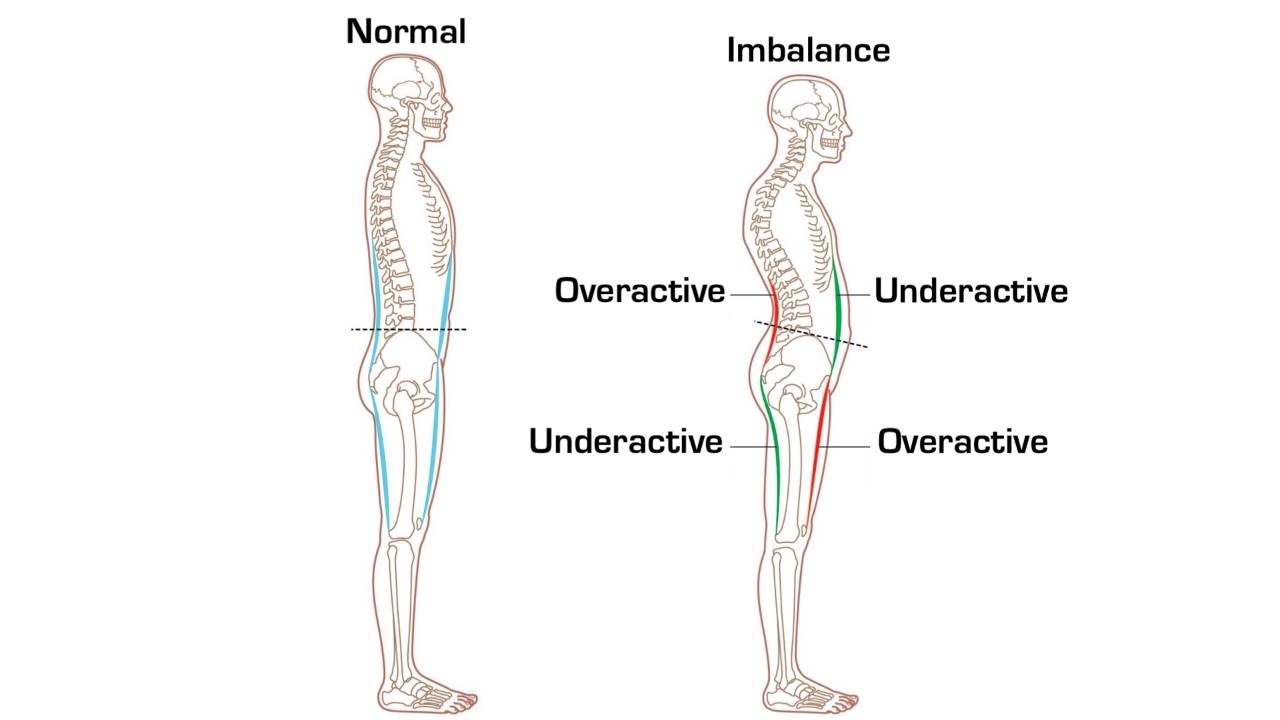
Back pain is one of the most common complaints people have and a global disability driver. In fact, the World Health Organization notes that low back pain has the highest prevalence among musculoskeletal conditions and is the leading cause of disability worldwide.
That matters because “back pain” is a label, but the cause depends on the person. In other words, while many people experience back pain, each cause of back pain is unique. The pain is just the symptom of something deeper, and the question you need to be asking is, “What is actually causing that pain?”
The cause is often due to a muscle imbalance.
In this article, we’ll explore how a muscle imbalance or muscle disbalance causes back pain and explore ways for how to fix muscle imbalances at home.
What Exactly Is a Muscle Imbalance?
A muscle imbalance happens when opposing muscles don’t share equal tension.
As an example, let’s use the arm. The biceps bend the elbow and the triceps straighten it.
If the biceps are too tight and the triceps are weak, the elbow can’t fully extend. That’s a small, easy-to-see imbalance.
Did you know that most imbalances occur in the core muscles around the spine? They’re harder to spot but much more impactful because when your core muscles are out of balance, posture breaks down, joints wear unevenly, and you’ll start feeling pain.
Muscle disbalance is extremely common. In fact, everyone has muscle imbalances. Some are mild, some severe, but no one is perfectly balanced. Because of this, back pain is also very common.
Posture: Voluntary and Involuntary
When most people think about posture, they are picturing standing up straight or sitting with their back against the chair rest and feet flat on the floor. However, posture is so much more than that.
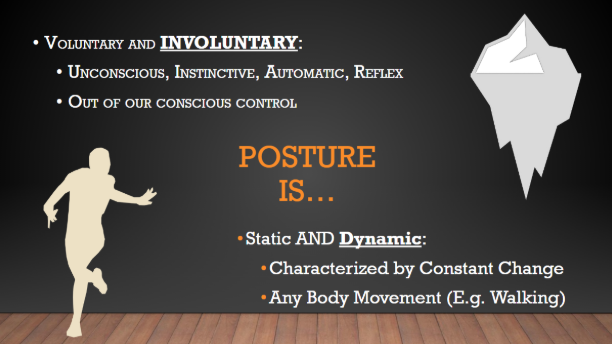
- Voluntary – the posture you can consciously correct.
- Involuntary – the unconscious, instinctive way your body holds itself.
That’s why when someone tells you “fix your posture,” it’s not always possible. Your body may be stuck in patterns outside of conscious control.
The fact of the matter is that posture is dynamic. Every movement you make, from walking to reaching for a cup, involves posture.
So, what controls your posture? It’s your muscles! And if the muscles that anchor your pelvis and spine don’t share the work evenly, your body will “choose” an easier position. That could mean muscle imbalances like anterior tilt, a little side-shift, or rounded upper back.
That’s an involuntary pattern driven by muscle imbalance, not a willpower problem.
Over time that uneven loading is a common driver of lower back pain. To effectively treat it, balance must be restored via deep core engagement and re-training opposing muscle groups so your involuntary posture starts to hold itself, even when you’re not thinking about it.
Pirate Ships Analogy for Posture
Here’s a fun way to picture it. Imagine the mast of a pirate ship. The mast is your spine and the ropes (called shrouds) are your muscles.
When the ropes pull with equal tension, the mast stands tall and straight. But if one side pulls harder than the other, the mast bends.
Your spine works the same way. If certain muscles are too tight while their opposites are too weak (creating muscle disbalance), your body gets pulled out of alignment, setting the stage for pain.
How Crossed Postures Lead to Less Muscle Imbalance
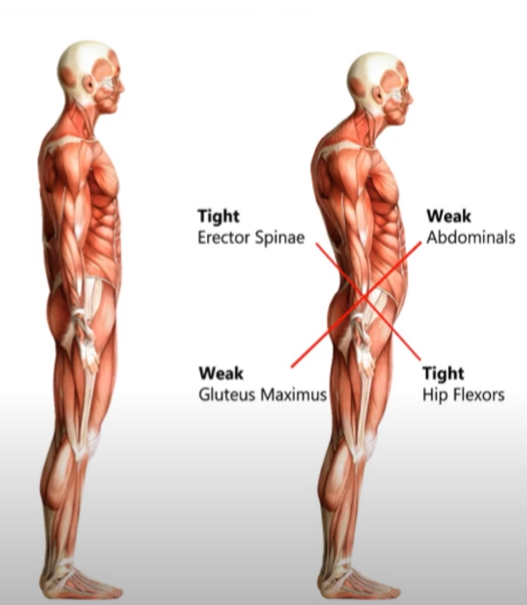
A brilliant doctor named Vladimir Janda studied these patterns and found that muscle imbalance isn’t random. They follow predictable rules, which he called crossed syndromes:
Lower Crossed Syndrome
Lower Crossed Syndrome is one of the most common muscle imbalance patterns tied to lower back pain. In this pattern, the hip flexors and lower back muscles become overactive and tight, while the abdominals and glutes lose strength and coordination. The result causes the pelvis to tip forward, the back arches, and the belly pushes forward. All of this makes the spine take on more of a load than it should.
Upper Crossed Syndrome
Upper Crossed Syndrome is the same “tug-of-war” concept, just higher up the chain. The chest and upper neck muscles get tight and dominant, while the mid-back muscles and deep neck stabilizers weaken and stop doing their job. Over time this pulls the shoulders forward and the head out in front of the body, creating the familiar rounded-shoulder, forward-head posture. That muscle disbalance can contribute to tension headaches, along with neck and shoulder pain.
When combined, these create “Cross-Posture Syndrome,” which is the all-too-common slouched posture that feeds chronic pain.
Why Understanding Muscle Imbalance Matters
The consequences of muscle imbalance goes far beyond “bad posture.” It changes how force travels through your body. When one group is tight and dominant while the opposing group is weak or underactive, your skeleton gets pulled out of alignment.
Muscle disbalance can lead to:
- Back pain (upper and lower)
- Sciatica
- Hip and knee pain
- Shoulder pain and stiffness
- Headaches and jaw pain (TMJ)
- Even plantar fasciitis in the feet
All because the muscles pulling on your skeleton are out of balance.
And to make it worse, just a small shift in head position, like leaning forward at a computer, can add 20 extra pounds of pressure on your spine.
What You Can Do to Improve Muscle Imbalances
If muscle imbalance is the problem, you need to find a way to restore balanced tension and control around your joints, so your body stops defaulting to the same compensations all day.
Start with these steps:
1) Identify the pattern
Pay attention to when your pain or tightness occurs the most. Does it happen while sitting? While you are walking? Or maybe it occurs most for when you are reaching up for something high on a kitchen shelf.
Muscle imbalances and their symptoms often follow predictable patterns, so consider what you are doing when the symptoms spike.
2) Use “core anchors” to find a supported position
A big reason posture can feel challenging to “fix” is that your body doesn’t know where neutral is. Three core anchors are the foundation of correct posture, and learning about them and how to engage these anchors puts your posture in a supported position.
Before moving on to number three, check out our Free 15 Minute Masterclass video discussing the core anchors so you know where they are and how they are engaged.
3) Connect it to real movement
Once you understand the core anchors and their impact in your postures, the next step is using them in your real daily movements. Start small with a couple activities at a time, like reaching for something or getting up from a chair. Once the process feels second nature, begin adding the retraining movements to other daily activities.
FAQ: Muscle Imbalance Answers
What are the most common signs of a muscle imbalance?
A muscle imbalance (sometimes called muscle disbalance) often presents as side-to-side differences in strength, stability, or flexibility, even if you can’t “see” anything wrong in the mirror.
Common clues include:
- One hip that always feels tighter
- One shoulder that is raised in comparison to the other
- A nagging ache that appears during specific activities but doesn’t feel tied to a single injury
Is it possible to fix a muscle imbalance at home?
Absolutely. The approach involves movement retraining and a focus on posture to reduce the patterns that are fueling the muscle imbalance. The way you use your body on a normal basis is the largest influence on your muscular balance and posture. You can restore muscular balance from anywhere by improving the way your core supports your spine when you sit, stand, and move.
Are lower back stretches enough to correct a muscle disbalance?
Usually not. Lower back stretches can feel relieving, but they don’t necessarily change the underlying push-pull relationship between opposing muscles. Lower back stretches provide temporary relief, but have no lasting impact because they do not address the nervous system, which has a major influence on muscle tension. The way to create lasting relief is through exercises that reeducate the neuromuscular system as a whole.
How long does it take to fix a muscle imbalance?
With the right program, people can start finding relief from muscle disbalance within the first week. However, it depends on the person and if there are any underlying structural issues that need to be addressed.
When it comes to fixing a muscle imbalance, you need to be consistent. The idea is to “retrain” your movements so the new balanced posture becomes natural in everything you do.
The Takeaway: Muscle Imbalance Is a Major Contributing Factor of Back Pain
Back pain often starts with muscle imbalance. In fact, muscle imbalances are the hidden root of so much pain. They:
- Pull the body out of alignment.
- Place excess stress on joints.
- Create predictable patterns of dysfunction.
The good news is that muscle disbalance is reversible. To learn more, check out our Free 15 Minute Masterclass video or set yourself up with a Free 7 Day Trial of Core Balance Training.
About the Author
Dr. Ryan Peebles is a Doctor of Physical Therapy specializing in spine and core rehabilitation since 2015. He has helped over 40,000 people overcome chronic back pain through his program Core Balance Training. In addition to his professional experience, he gained deep insight from a decade-long personal struggle to overcome lower back pain.